
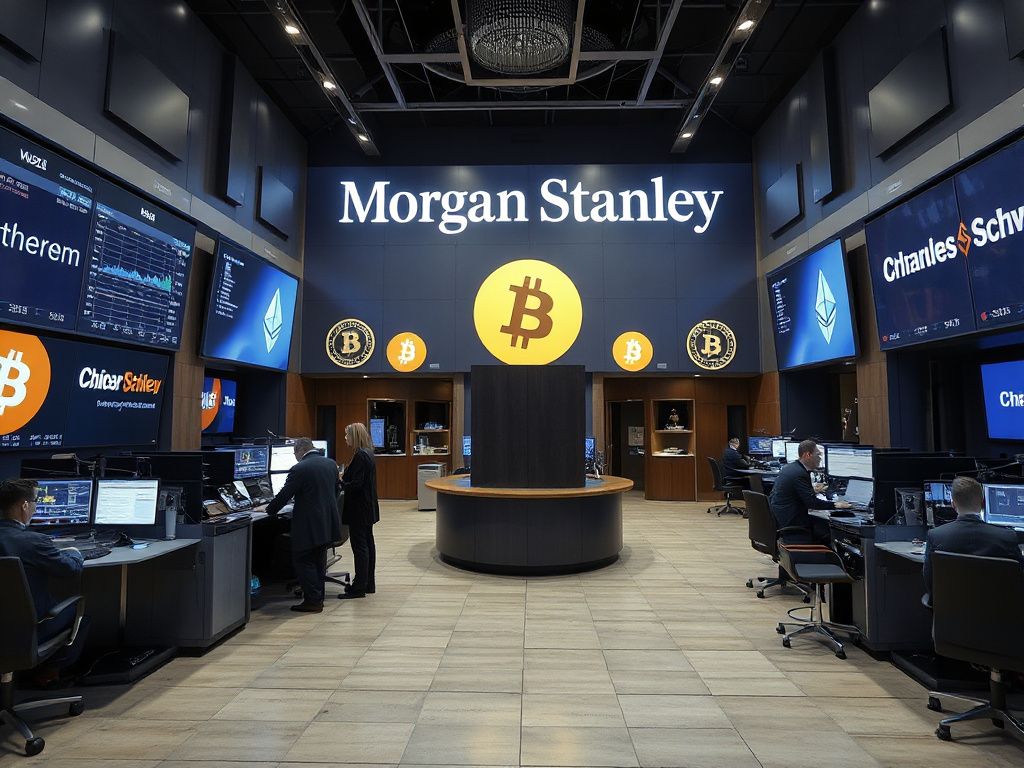
Traditional Brokerages Ignite a New Crypto Trading Fee War
In early May 2026, the landscape of retail crypto trading shifted dramatically as two of the United States’ largest brokerage firms entered the spot‑trading arena with aggressively priced offerings. E*TRADE, now a subsidiary of Morgan Stanley, rolled out a pilot service that lets customers trade Bitcoin, Ethereum and Solana at a flat fee of 50 basis points (0.5%) per transaction. This fee undercuts Charles Schwab’s newly launched Schwab Crypto platform, which charges 75 basis points (0.75%) for spot Bitcoin and Ether trades, and it also competes directly with Robinhood’s variable spreads that range from 35 to 95 basis points. By leveraging the deep trust and custodial infrastructure of their parent firms—Morgan Stanley’s Premier Bank and Schwab’s partnership with Paxos—both brokerages aim to attract retail investors who have traditionally kept crypto holdings on standalone exchanges, promising a seamless integration of crypto assets into existing retirement and brokerage accounts.
The emergence of this pricing war reflects a broader strategic push by legacy financial institutions to capture a slice of the rapidly expanding digital‑asset market. Analysts note that the fee structures introduced by Morgan Stanley and Schwab are not merely about undercutting competitors; they signal a willingness to standardize crypto trading costs at a level that rivals the most cost‑effective crypto‑native platforms. While Robinhood’s spread can be as low as 35 basis points for high‑volume traders, its model still relies on a fragmented fee architecture that includes hidden costs such as payment‑for‑order‑flow. In contrast, the flat‑fee approach adopted by the brokerages offers greater price transparency, which could appeal to risk‑averse investors seeking to consolidate their portfolios under a single custodial umbrella. This shift also puts pressure on pure‑play exchanges to either lower their fees or enhance their value proposition through superior liquidity, advanced order types, or exclusive token listings.
For retail investors, the practical implications are immediate. Clients who already hold retirement assets with Morgan Stanley or Charles Schwab can now add Bitcoin and Ethereum to the same account, simplifying tax reporting and potentially reducing custodial fees. The geographic rollout, however, remains limited—Schwab Crypto is unavailable in New York, Louisiana, and outside the United States, while E*TRADE’s pilot is initially restricted to a subset of its user base. As both firms expand their services throughout 2026, the competitive dynamics are likely to intensify, prompting further fee adjustments and possibly spurring additional legacy players to launch their own crypto desks. Ultimately, the convergence of traditional brokerage trust, transparent pricing, and integrated custody may reshape how everyday investors engage with digital assets, nudging the market toward a more mainstream, regulated environment.